Record mar-01, printed 14 September 2026. Every animal on this sheet has its own page and its own source at that address.
Marusja DBE
Domestic Shorthair · DBE-MARU · line: Marusya · both eyes blue, put down to a DBE variant or its line · Genotyped
Genealogy trace, one printable page carrying the proposed code
Under the variant field this directory proposes, this cat would read DBE 161p. A carrier of a variant with no published allele, on no named line. This is the group bare 161 exists for. The proposal is set out in full here, and no registry issues this field today: it is computed from the record at each build and is not part of any registration.
How this cat is connected to the trait
A laboratory has tested this animal itself, so nothing has to be traced: the result is on the cat.
No parent is recorded for this cat in the register, so no genealogy can be drawn. That is a gap in the sources, not a statement that the cat had none. Any offspring the register holds are listed below.
More than one variant could be present in this cat
DBE-ALT and DBE-MARU. More than one variant could be present in this cat: DBE-ALT, DBE-Maru. It is not established that any of them is, and it is not established that two are. A dominant allele comes from a parent, and this cat's recorded ancestry carries an attribution of each. A cat holding two is a compound heterozygote, which this survey records as the state associated with deaf and dead kittens, and nothing but a test distinguishes one from two.
Computed from the recorded parentage at every build, counting both the variants this survey adopts and the ones it records a source claiming and does not adopt. It is an upper bound and not a finding: it says what could be here, never what is.
What is flagged
- MARUSJA DBE. Breed confirmed by the researcher, and the certificate is wrong. The WCF Astra certificate RU 0184/H-0133-2965-24 riex prints this animal in its Great-Great-grandparent column as marusya, EXO n 03 24, which would make the founder of the line an Exotic Shorthair. Professor Marie abitbol states that she is a domestic shorthair and not an exotic, in correspondence of 2 September 2026, and this register already held her as a domestic shorthair and as not a pedigree cat. The register and the researcher agree and the certificate is the odd one out: its reading is recorded here and is not adopted, because a breed written into a descendant's pedigree four generations up is the club transcribing what it was told rather than a registration of the animal itself. Why the line's records are thin. The same correspondence states that the breeder carried out many crossings on to Exotic Shorthair, Persian and British Shorthair backgrounds, produced many of this animal's offspring, and that the pedigree data were not always recorded. That is the reason this line is held largely without parent links and it is the breeder's own account, not an inference. Two photographs of her are held on the messybeast archive and the breeder supplied further pictures to the researcher; none is in this register. S_ABITBOL_224. Three photographs of her are now held, confirmed as this animal by the compiler on 2 September 2026, and the founder has a face on this register for the first time: a still captioned Marusya from the researcher's own presentation slide, a close-up in which both blue eyes are plain, and one of her nursing a litter. The close-up is the one published, credited to the breeder's own public post, which is where she carries it. They are photographs and not evidence of a determinant. S_MARUSYA_PHOTO_226. Phenotype proposal on the founder, and it is a proposal and nothing more. The compiler, on reading the three photographs of this animal on 2 September 2026, records that she carries the look of both the DBE-ALT and the Igor lines. That is a statement about appearance and it is not a genotype, not a pedigree and not an attribution this register adopts. It is held in the claimed field, which is never walked, so nothing descends from it and no count anywhere on this site moves because of it. Why it is worth recording anyway: if the founder of a line held as its own unnamed variant looks like two named ones, then whether these are separate determinants at all is a real question, and Professor Abitbol's own position is that every published dominant blue eye variant so far lies in PAX3. The only thing that would settle it is a genotype, and no animal of this line has one. S_MARUSYA_PHENO_227 | the variant is named and she is the cat it is named for, 12 September 2026. Abitbol M, Eisele T and Lipovenko E, 'Additional PAX3 Variants for Dominant Blue Eyes in Cats', Animal Genetics 2026;57:e70199, doi:10.1002/age.70199, open access, read 12 September 2026 names the allele DBE-MARU, Marusya Dominant Blue Eyes, PAX3 XM_019838731.3:c.784C>T, a nonsense variant in the fifth exon, predicted to truncate the protein at p.(Arg262*) and so to remove 46 per cent of it. She is recorded heterozygous. All 14 DBE cats of the line were heterozygous, the one non-DBE cat of the family was wild-type, and the allele was absent from the 99 Lives dataset of 348 cats and from every DBE cat of every other line tested. The proposal that she shows DBE-ALT and the Igor line together is withdrawn by this result and is no longer carried in any field. It was a reading of her appearance and never a test, it was held in the claimed field and never walked, and a published genotype now replaces it. One homozygote is recorded and it was an abnormal kitten, Dead at birth, out of two DBE parents. The paper states that no data is available on the hearing status of any DBE cat in this line. S_PAX3_2026_234 | where this variant sits in PAX3. A third party compilation places DBE-MARU at EXON 5, a coding variant. The register records the position and does not adopt it as its own finding: a schematic on a website is not a paper, and where this register needs the science it cites the papers directly. It is recorded because it is checkable, and because the position in the gene is the one thing about these variants that a breeder can never observe and a laboratory never reports on a result sheet. S_LOCI_272
A flag is not an error. It marks a place where two sources say different things, or where an attribution cannot be made on the evidence held.
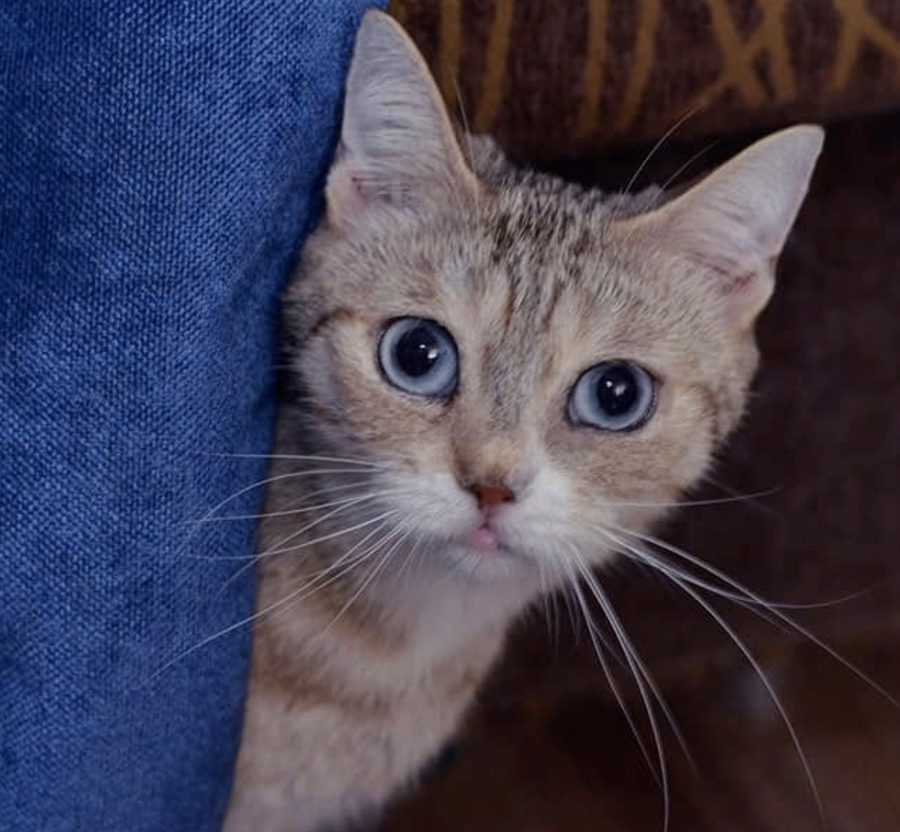
The record
- Register id
- mar-01
- Sex
- not stated by the source
- Breed, as stated
- Domestic Shorthair
- Line
- Marusya
- Variant
- DBE-MARU
- Eye status
- blue-variant: both eyes blue, put down to a DBE variant or its line
- Eyes, in the source's words
- both blue
- Role
- founder
- Relations named by the source
- three matings charted: to Greg once and to Alex twice
- Country
- Russia, Volgograd
- Year
- line founded 2019
- Photograph credit
- Photograph: the Cyrridwen cattery, from the breeder's own public post
- The description held
- brown patched tabby and white; not a pedigree cat the variant of this line is DBE-Maru and two copies of it are not survivable on the evidence held. The allele is PAX3 XM_019838731.3:c.784C>T, a nonsense variant in the fifth exon that truncates the protein at p.(Arg262*) and removes 46 per cent of it. All 14 dominant blue eyed cats of the line tested are heterozygous. One homozygote is on record and it was an abnormal kitten, Dead at birth, out of two dominant blue eyed parents, genotyped T/T. It is recorded against every animal of the line because a breeder looks up an animal and not a line. What it means in practice: mating two carriers together is expected to lose the quarter of the litter that inherits two copies, and because those kittens do not survive to be counted, a breeder doing it may see only small litters and conclude nothing is wrong. It is a different and worse harm from the compound heterozygote this register documents elsewhere, which is white and deaf and which lives. No hearing data exists for any cat of this line, which the authors state explicitly, so nothing is said here about deafness in it either way. Source: Abitbol M, Eisele T and Lipovenko E, 'Additional PAX3 Variants for Dominant Blue Eyes in Cats', Animal Genetics 2026;57:e70199. S_PAX3_2026_236
- Evidence grade
- DNA genotyped a laboratory result exists for this animal
In the register
- Offspring recorded : Cyrridwen Mishka
Source
the Cyrridwen chart. The suffix DBE is carried on appearance; no test result is shown for her or any descendant; and Abitbol M, 'CORIN and DBE variants in cats: what we know and what remains to be explored', World Cat Federation, 2026. A presentation and not a published paper | dbecats.com, the variants section and its PAX3 schematic, read 13 September 2026. A third party compilation and not a paper. The diagram is captioned as schematic and not drawn to genomic scale, and the site states that six of the variants it lists are characterised in peer-reviewed research
This directory is a working aid compiled from published charts, registry documents and breeder statements. It is not a register and it has no standing of any kind. The grade attaches to the animal, not to the line: a cat whose ancestor was genotyped is line-traced, not genotyped.